The birth of George Stark
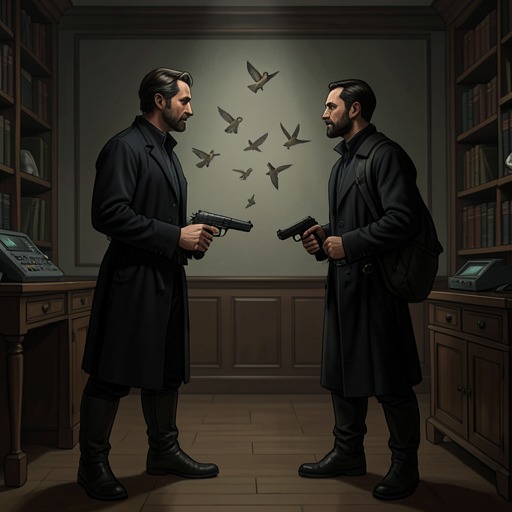
The Dark HalfThe birth of George Stark begins as a deliberate solution to Thad Beaumont’s writer’s block: Beaumont wants an identity separate from his own, one capable of carrying a different kind of book. Inspired by crime writer Donald E. Westlake’s pseudonym Richard Stark and the ruthless criminal Parker, Beaumont creates a commercially successful crime novelist whose fictional independence becomes increasingly difficult to distinguish from his own. In retrospect, the origin story is both a history of pen-name publishing and the first step toward the novel’s unsettling convergence of invented identity and real violence.
A Separate Authorial Identity
Beaumont recalls that finding the name mattered because the right identity might break the writer’s block he was struggling with. He had been reading the career of Donald E. Westlake, who wrote comic social novels under his own name and a much harder series about Parker as Richard Stark. For Beaumont, the distinction offered a model: one author could write through identities that seemed to belong to different imaginative worlds.
The reference was not merely to a second byline. Westlake had described writing his own books on sunny days and letting Stark take over on rainy ones. Beaumont connected that division to his own difficult period between 1973 and early 1975. He was drawn in particular to Parker’s narrow, relentless purpose: a professional thief with little apparent life beyond robbery, moving through other criminals with machine-like persistence. That model helped him imagine the voice of Alexis Machine, protagonist of the first and last George Stark novels.
Beaumont says the first version of Machine’s Way initially seemed too derivative to publish. About a quarter of the way through, however, the book found its own rhythm and the material began to cohere. Asked whether George Stark had begun to speak through it, Beaumont accepts that description as close enough. The account leaves the boundary deliberately unstable: Stark starts as a chosen literary device, yet Beaumont describes the writing process as if the invented author acquired a voice of his own.
The First Book and Its Method
Beaumont began Machine’s Way on the night in 1975 when he came up with the name. He put a sheet of paper into his typewriter, then pulled it back out. Although he had typed all his other books, he says George Stark apparently did not share that preference. Beaumont instead found an old notebook and wrote with pencils from a jar on his desk.
The difference in method became part of the identity. Beaumont recalled starting to write and next realizing that Liz was telling him it was midnight and asking whether he was coming to bed. Liz remembered waking at 11:45, finding him out of bed, and assuming he was writing; because she could not hear the typewriter, she became frightened. She was relieved when she learned what had happened. Her memory supplies an intimate counterpoint to Beaumont’s account: the new authorial voice first appeared not as a public revelation but as a silent, unexplained change in the household’s nighttime routine.
When Beaumont looked back through the notebook, he found sixteen pages without a single scratch-out and discovered that he had sharpened three-quarters of a new pencil down into shavings. He did not ordinarily write that way: his hand tired, and he felt unable to work without a typewriter. He tried using Stark’s pencils himself after Stark was dead, but it did not work for him. The material distinction between Beaumont’s typewriter and Stark’s longhand thus became a compact emblem of the separate identity he had set out to create.
The Public Success of the Pen Name
Machine’s Way appeared in June 1976 through the smaller Darwin Press, while Beaumont’s books under his own name had been published by Dutton. The novel became that year’s surprise bestseller, reaching number one across the country, and was made into a successful film. The distinction between the two authorial identities therefore had a practical foundation in publishing: separate names, publishers, and audiences, even though Beaumont was the writer behind both.
The secret was known to a limited circle. Beaumont says his agent knew, as did the agent’s then-wife, who remained a full partner in the business, senior executives and the comptroller at Darwin Press, and the Internal Revenue Service. The copyright was registered to George Stark, but Stark’s longhand created a problem when it came time to endorse checks. For about a year and a half, Beaumont and Liz waited for someone to expose the arrangement; nobody did. The elaborate concealment depended not on perfect separation but on people who knew remaining silent.
That silence held for another ten years, during which Stark published three more novels. None matched the spectacular success of Machine’s Way, but all made their way onto bestseller lists. In the crime-fiction world described by the novel, the books also attracted readers who valued precisely the hard-edged genre Beaumont had chosen to write under the pseudonym. Dodie Eberhart, a crime-novel reader and Stark fan, regarded him as the best in that field and had followed his books from Machine’s Way and Oxford Blues through Riding to Babylon. Stark’s invented identity had become legible to readers as a distinctive authorial career.
Ending the Charade and Its Afterlife
The pen name brought Beaumont money as well as relief from the limits of his public career. He recalls that Stark’s earnings meant he could leave teaching if he chose and continue paying the mortgage; he thought of that financial freedom as his “f-you money.” Yet Stark was also running out of things to say. Beaumont wanted to write his own books again, and Liz, his agent, and perhaps Stark’s editor recognized that the pseudonymous series was nearing its end.
Keeping the secret would have left open the temptation to write another profitable Stark novel. Beaumont therefore decided to end the charade by going public. When the secret later became a source of suspicion in the murder investigation, Thad could point out the apparent weakness of a motive attributed to him: after he had exposed his own identity as Stark, killing a would-be blackmailer made little practical sense. The publishing history that began as a private division of authorial identity had become entangled with public evidence and the interpretation of crime.
The origin story also casts Stark’s fictional violence against the conventions that first inspired him. Beaumont compares Parker to a programmed machine, driven by a single objective, and Dodie Eberhart’s account of her taste in crime fiction places Stark among stories of robbery, violence, and criminal loyalties. Later, an actual attacker associated with Stark’s world waits for Michael Donaldson in the hallway outside his apartment and attacks with a straight razor. The resemblance between the hard crime books and events in the real world does not make the fictional origin a simple explanation for the murders; it shows how the novel makes genre, pseudonym, and violence press against one another. George Stark is born as Beaumont’s means of separating two kinds of writing, but the story ultimately makes that separation the very thing that can no longer be trusted.